
Last Updated: November 2026
You’ve got a power of attorney for a parent in Mexico, a diploma for a job in Spain, or a marriage certificate for a visa in Italy. Someone told you it needs “a stamp.” Now you’re stuck on the same question many of our clients ask: apostille vs notarization, what’s the difference, and which one does your document actually need?
Here’s the short version: a notarization proves who signed a document, while an apostille proves to another country that the official seal or signature on the document is real. They’re different steps, done by different people, and many documents going abroad need both.
In this guide, you’ll learn what each one does, how the process works in Oregon and in Vancouver, Washington, what the state fees are as of November 2026, and the mistakes that send documents back. No legal jargon. Just a clear path.
Key Takeaways
- Notarization is domestic. A notary confirms the signer’s identity and completes a notarial certificate. It doesn’t make a document valid abroad on its own.
- An apostille is for use abroad. The Oregon or Washington Secretary of State (or the U.S. Department of State for federal records) attaches it to confirm the official signature already on the document.
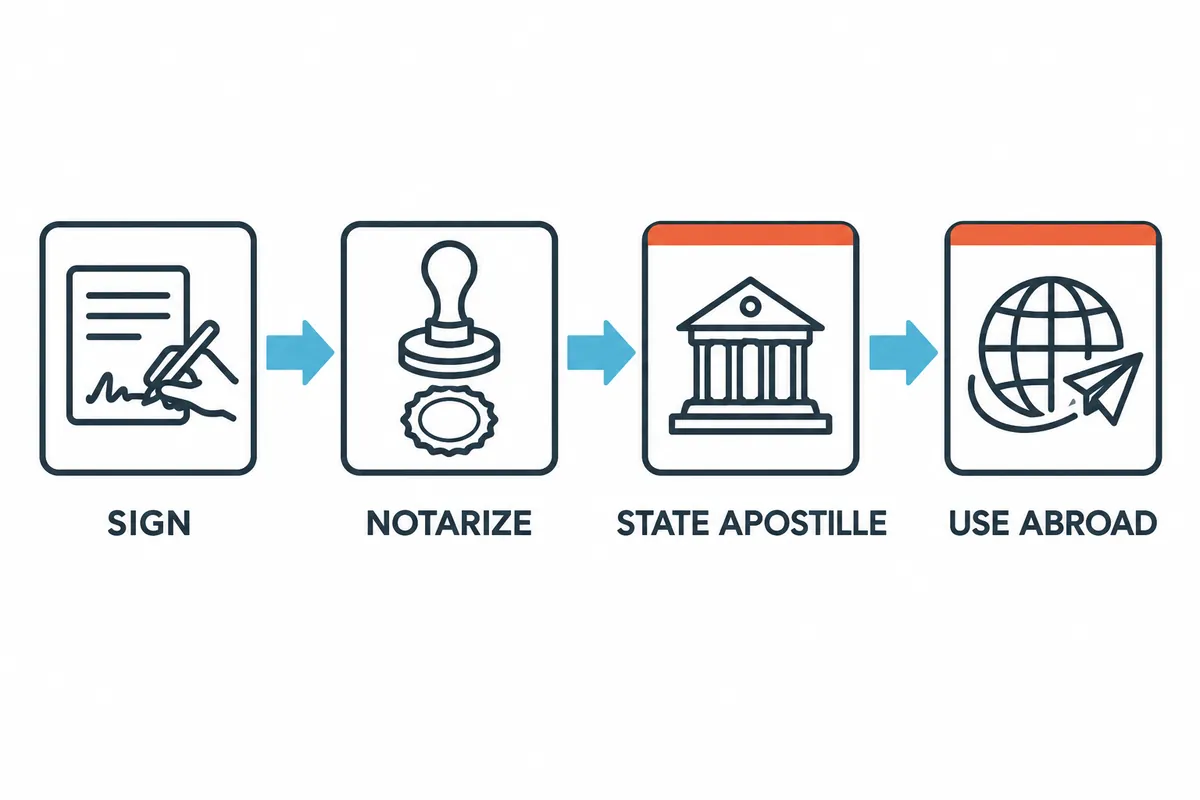
- The order matters. Many personal documents get notarized first, then apostilled by the state where the notary is commissioned.
Apostille vs. Notarization: What’s the Difference in Plain English?
Quick answer: A notarization is when a notary public confirms who signed a document and completes a notarial certificate with their seal. An apostille is a certificate from a Secretary of State or the U.S. Department of State that confirms that seal or official signature so another Hague Convention country accepts it.
Think of it as two locks on the same door. The notary locks in the signer’s identity. The apostille locks in the notary’s (or official’s) authority, so a foreign government doesn’t have to guess whether an Oregon notary is real.
Most people miss this: an apostille does not check what your document says. The Oregon Secretary of State states plainly that an apostille “does not validate the substance, contents and/or legal effect of the document.” It only certifies the signature, seal and position of the official.
What a Notarization Does (and Doesn’t Do) in Oregon
Notarization is a fraud-prevention step. An Oregon notary public verifies your identity with acceptable ID, confirms you’re signing willingly, and completes a certificate such as an acknowledgment (you confirm the signature is yours) or a jurat (you swear or affirm the contents are true).
A notary doesn’t give legal advice, choose your document type or confirm your document is legally enforceable. Under Oregon law (ORS 194.400), a notary may charge no more than $10 per notarial act, or $25 per act for remote online notarization, as of November 2026. A mobile notary may add a travel fee only if it’s explained and agreed in advance.
Notarization is usually all you need for documents staying in the U.S., like a lease, an affidavit for a local court or a power of attorney for an Oregon bank. If you want a refresher on the role itself, our guide on what a notary public does in Oregon covers the basics.
What an Apostille Does and Who Issues It
An apostille is a certificate created by the 1961 Hague Apostille Convention. When a document goes to a country that belongs to the Convention, the apostille replaces the old chain of embassy legalization with one certificate.
Who issues it depends on where the document came from:
- Oregon documents: the Oregon Secretary of State, Corporation Division, in Salem. This covers documents notarized by an Oregon notary, Oregon vital records signed by the State Registrar, certified county records and court documents signed by a circuit clerk or judge.
- Washington documents: the Washington Secretary of State. This covers personal documents notarized by a Washington notary and records issued by Washington government offices.
- Federal documents: the U.S. Department of State Office of Authentications. Think FBI background checks, naturalization certificates and other records signed by federal officials.
One detail surprises people. Both states say their apostilles are not valid for use inside the United States. If your document stays in the U.S., an apostille won’t help you.
Which One Do You Need? A Quick Decision Guide
Let’s be honest: the question isn’t really “which is better.” It’s “where is this document going, and who signed it?” Work through these questions in order:
- Will the document be used outside the U.S.? If no, you likely need notarization only (if the receiving office requires it).
- Is it a personal document you sign, like a power of attorney, affidavit or consent letter? Get it notarized first, then apostilled by the state where the notary is commissioned.
- Is it an official record, like a birth certificate or divorce decree? Order a certified copy from the issuing office. Don’t notarize the original. The certified copy goes straight to the state for the apostille.
- Is it a federal document, like an FBI background check? It goes to the U.S. Department of State, not to Oregon or Washington.
- Is the destination country outside the Hague Convention? You may need extra authentication and embassy legalization. Check with that country’s embassy first.
In our experience, step 3 trips up the most families. A notary can’t certify a copy of a birth, death or marriage certificate in Oregon. You need the certified copy from the vital records office or county.
Not sure which path your document needs? PDX Signing handles the notarization and the apostille paperwork together through our expedited apostille services in Portland, Oregon. Tell us the document and the destination country, and we’ll map out the steps.
Side-by-Side Comparison: Notarization vs. Apostille
Here’s how the two compare at a glance, using Oregon and Washington official figures as of November 2026.
| Notarization | Apostille |
Purpose | Confirms the signer’s identity and willingness | Confirms the official signature or seal so a foreign country accepts it |
Who does it | A commissioned notary public | Oregon or Washington Secretary of State, or U.S. Department of State for federal records |
Where it’s used | Mainly inside the U.S. | Only outside the U.S. |
Checks the content? | No | No |
Oregon government fee | Up to $10 per notarial act ($25 for remote online), plus any agreed travel fee | $10 per apostille, one per document |
Washington government fee | Not covered in this guide | $15 per document; expedited adds $100 per 10 documents |
Typical timing | Same appointment | Oregon: about 10 business days by regular mail, 2 to 3 via FedEx or UPS. Washington: 7 to 10 business days standard, 2 to 3 expedited |
Sources: Oregon Secretary of State apostille requirements and the Oregon apostille brochure; Washington Secretary of State apostille services; ORS 194.400. Government fees change, so confirm before you send.
If you’d rather not handle the mailing and follow-up yourself, PDX Signing lists its apostille service at as low as $125 per apostille, with an estimated processing time of 3 to 7 business days, as of November 2026.
How Notarization and Apostille Work Together in Oregon
For a personal document headed abroad, the two steps happen in a fixed order. Here’s the typical Oregon path:
- Prepare the document in its final form, including any translation the destination country requires.
- Sign in front of an Oregon notary, who completes a full notarial certificate with seal, signature and date.
- Complete the Request for Authentication form and list the destination country.
- Send the original (never a photocopy) to the Corporation Division in Salem with the $10 fee per document.
- Receive the apostille attached to your document, then send it to the foreign office that asked for it.
Pro tip: Oregon’s Secretary of State doesn’t translate documents. If the country wants a translation, get the translation done and notarized before the apostille, not after. Our certified document translation services can fit into that same sequence.
Timing matters most when the signer can’t travel. A parent in a care home or a patient in the hospital can still sign a power of attorney for property overseas. Our mobile notary services come to homes, offices, hospitals and assisted living facilities across the Portland metro, so the notarization happens at the bedside and the apostille step follows.
Oregon vs. Washington: What Changes If You Live in Vancouver
Vancouver, WA residents often work in Portland, sign in Portland, or have a Washington notary at their bank. Here’s the thing: the state that apostilles your document is the state where your notary is commissioned, not where you live.
| Oregon | Washington |
Apostille office | Secretary of State, Corporation Division, Salem | Secretary of State, Corporations and Charities, with in-person same-day service in Tumwater or Cheney |
Notarized documents accepted | Signed by an Oregon notary | Signed by a Washington notary with a full notarial certificate |
Fee as of November 2026 | $10 per apostille | $15 per document; same-day in person adds $150 for the first 10 documents |
Non-Hague countries | Same certificate form used for all countries | Universal certificate; non-Hague countries may also need U.S. Department of State or embassy certification |
So if an Oregon notary notarizes your affidavit, it goes to Salem. If a Washington notary notarizes it, it goes to Washington. Mixing the two is a common reason for a rejected request.
Federal Documents: When the U.S. Department of State Handles the Apostille
Some documents skip the state entirely. Records signed by federal officials, such as an FBI Identity History Summary, a certificate of naturalization or an IRS tax residency certification, get their apostille from the U.S. Department of State.
The Oregon Secretary of State says it cannot authenticate a records check from the FBI. And the Department of State warns: don’t notarize a federal document. Notarizing it can make it unusable for a federal apostille.
Federal processing times are set separately from state times, so check the current times on the Department of State’s authentication page before you book travel. If you need a background check apostilled, plan this step first.
Common Mistakes to Avoid
Assuming a notary stamp is enough for use abroad. A notarized document isn’t certified for a foreign government by itself. If it’s leaving the U.S., ask the receiving office whether it needs an apostille.
Notarizing a vital record instead of ordering a certified copy. Oregon notaries can’t certify copies of birth, death or marriage certificates. Order a certified copy from the Oregon Center for Health Statistics or the county instead.
Sending a Washington-notarized document to Oregon (or the reverse). Each state only authenticates its own officials. Match the apostille office to the notary’s commission state.
Notarizing an FBI background check. Federal records go to the U.S. Department of State as issued. Adding a notarization can cause a rejection.
Removing the apostille to add a page. Oregon says removing an attached certificate invalidates it. Finalize every page before you submit.
Mailing originals without tracking. Oregon recommends FedEx or UPS for time-sensitive documents. Regular mail is slower and riskier for originals.
Frequently Asked Questions
Is a notarized document the same as an apostilled document?
No. A notarized document has a notary’s certificate for U.S. use. An apostilled document also has a state or federal certificate so a foreign country accepts that signature.
Do I need both a notary and an apostille?
Often, yes. Personal documents like a power of attorney are notarized first, then apostilled. Certified vital records and federal records skip the notary step.
Can a notary issue an apostille in Oregon?
No. Only the Oregon Secretary of State issues apostilles for Oregon documents. A notary handles the notarization that comes before it.
How much does an apostille cost in Oregon?
As of November 2026, the Oregon Secretary of State charges $10 per apostille, with one apostille needed for each document. Shipping and service fees are separate.
How much does a Washington apostille cost?
As of November 2026, Washington charges $15 per document. Expedited processing adds $100 per 10 documents, and same-day in person adds $150 for the first 10.
How long does an apostille take in Oregon?
Oregon’s brochure says to allow about 10 business days by regular mail and 2 to 3 business days via FedEx or UPS, plus shipping time.
How do I know if I need a federal or state apostille?
Look at who signed the document. Federal officials’ records, like FBI checks, go to the U.S. Department of State. State-notarized and state-issued records go to that state.
Can Oregon apostille my FBI background check?
No. The Oregon Secretary of State can’t authenticate FBI records checks. Those go to the U.S. Department of State Office of Authentications.
Is an apostille valid for use in the United States?
No. Both Oregon and Washington state that their apostilles aren’t valid for use inside the U.S. For domestic use, notarization is usually what’s required.
Can I get a document notarized in a hospital for use abroad?
Yes. A mobile notary can notarize at a hospital or care facility if the signer is alert, willing and has valid ID. The apostille request follows afterward.
Conclusion: Apostille vs. Notarization, Settled
So, apostille vs notarization, what’s the difference? Notarization confirms who signed. An apostille confirms the official behind that signature so a foreign country will accept it. Here’s what to remember:
- Documents staying in the U.S. usually need notarization only.
- Personal documents going abroad usually need notarization first, then an apostille from the notary’s state.
- Oregon charges $10 per apostille and Washington charges $15 per document, as of November 2026.
- Federal records like FBI checks go to the U.S. Department of State, and they shouldn’t be notarized.
Get the order right and your documents arrive ready to use. You’ve got this.
Ready to get your document notarized and apostilled without the guesswork? Contact PDX Signing or call +1 971 708 3000, and we’ll handle both steps for you in Portland, the metro area and Vancouver, WA.